Key takeaways
- Estrogen in men is produced primarily via aromatization of testosterone, an enzyme called aromatase converts some circulating testosterone into estradiol (E2).
- Low or "crashed" estradiol, often from overuse of AIs, is underrecognized and more damaging than mildly elevated E2.
- Healthy young men typically have ratios around 25-30:1 (in comparable units).
- The first line of defense when estradiol rises is almost never an AI.
- A small minority of men genuinely need aromatase inhibition, typically those who aromatize heavily due to genetics, are overweight, or experience persistent symptomatic high E2 despite protocol optimization.
If you've been on TRT, or read anything about it, you've probably encountered "aromatase inhibitors" (AIs) like anastrozole (Arimidex) or exemestane (Aromasin). For 15 years, they were handed out automatically to men on TRT. The theory was simple: testosterone converts to estrogen via aromatase, high estrogen is bad, so suppress it.
That theory has not aged well. Modern TRT practice is moving sharply away from prophylactic AI use for one simple reason: estrogen isn't the enemy, imbalance is. Men need estrogen. It drives bone density, libido, cognitive function, cardiovascular health, and mood. Crashing it chasing an arbitrary number causes more problems than it solves.
This article walks through when estrogen management matters, when it doesn't, and how to think about it in 2026.
Why men have estrogen in the first place
Estrogen in men is produced primarily via aromatization of testosterone, an enzyme called aromatase converts some circulating testosterone into estradiol (E2). This happens mostly in fat tissue, the liver, the brain, and bone.
Normal male estradiol levels: 20-40 pg/mL. This level is necessary for:
- Bone density, estrogen is the dominant driver of bone health in men, more than testosterone itself (Finkelstein et al., N Engl J Med 2013)
- Libido, men with crashed E2 often report near-total loss of sexual drive despite high testosterone
- Erectile function, E2 plays a role in vascular and neurological signaling
- Mood and cognition, crashed estrogen causes depression, anhedonia, and joint stiffness
- Joint lubrication, estrogen supports cartilage and connective tissue
- Lipid profile, E2 improves HDL and reduces cardiovascular risk
What elevated E2 on TRT actually looks like
Some men do experience genuinely elevated estradiol on TRT. Signs:
- Nipple sensitivity, itchiness, or swelling (gynecomastia)
- Significant water retention and bloating
- Emotional lability, irritability, or moodiness
- High blood pressure without clear cause
- E2 consistently above ~50 pg/mL on lab (sensitive assay) with symptoms
The key word above: with symptoms. A number alone is not a problem if you feel good.
What crashed E2 on TRT looks like
Low or "crashed" estradiol, often from overuse of AIs, is underrecognized and more damaging than mildly elevated E2. Symptoms include:
- Severe loss of libido, often total
- Erectile dysfunction despite good testosterone levels
- Anhedonia and depression, flat affect, loss of motivation
- Joint pain and stiffness, "cracking knees," sore morning joints
- Fatigue that doesn't respond to more sleep
- Loss of mental sharpness, foggy thinking
- Accelerated bone loss over time, silent but real (Burnett-Bowie et al., J Clin Endocrinol Metab 2009)
If you're on TRT and feel worse instead of better, crashed estrogen is one of the first things to check.
The principle most men get wrong: E2 at 45 pg/mL with no symptoms is fine. E2 at 18 pg/mL with joint pain, low libido, and fatigue is a problem. Lab numbers are context, symptoms are signal.
The testosterone-to-estrogen ratio
A more useful concept than absolute E2 is the T:E2 ratio. Healthy young men typically have ratios around 25-30:1 (in comparable units). This ratio matters more than either number in isolation. A man with total T of 900 ng/dL and E2 of 40 pg/mL is in balance. A man with T of 1,200 and E2 of 40, same E2, higher T, might actually feel better despite the "high" E2.
How to prevent high E2 without an AI
The first line of defense when estradiol rises is almost never an AI. It's protocol optimization:
1. Split your testosterone dose
Large weekly doses of testosterone produce large aromatization spikes. Splitting the weekly amount into two injections rather than one dramatically reduces E2 peaks for most men.
2. Reduce the total testosterone dose
If your T is at 1,400 ng/dL and your E2 is 60 pg/mL, the issue isn't estrogen, it's too much testosterone. Dropping T dose often normalizes E2 automatically.
3. Reduce HCG dose if on HCG
HCG stimulates intratesticular testosterone, which aromatizes significantly. If E2 rises specifically after adding HCG, the HCG dose is usually the culprit. Reduce it before adding an AI.
4. Lose body fat
Fat tissue is where most aromatization happens. Men with high body fat aromatize much more testosterone to estrogen than lean men. Over time, losing fat drops E2 naturally.
5. Address insulin resistance
Elevated insulin raises aromatase activity. Tightening up carbs, adding zone 2 cardio, and improving insulin sensitivity all help.
When an AI is actually warranted
A small minority of men genuinely need aromatase inhibition, typically those who aromatize heavily due to genetics, are overweight, or experience persistent symptomatic high E2 despite protocol optimization. For these men:
Anastrozole (Arimidex)
Prescribed and monitored by a physician, with the dose set against your own labs rather than a fixed number. It is worth knowing how thin the evidence here is: the controlled trial most often pointed to gave older men with mild hypogonadism anastrozole at 1 mg daily or 1 mg twice weekly, and although testosterone rose and estradiol fell, scores for quality of life, erectile function and urological symptoms did not improve (Leder et al., J Clin Endocrinol Metab 2004). Aromatase inhibition moves the numbers. Whether it makes men feel better is a separate question, and one the evidence has not settled.
Exemestane (Aromasin)
An irreversible inhibitor, dosed less frequently than anastrozole. Some prescribers prefer it for reduced estrogen rebound.
Natural alternatives
Marginal but real. Some men do well with calcium-D-glucarate, DIM (diindolylmethane), or zinc to support estrogen metabolism before resorting to pharmaceutical AIs.
The AI rule of thumb: start with the lowest dose possible, infrequently. Measure E2 at 2 weeks. Adjust downward if low-normal. Never chase a "low" E2 number as the goal, chase how you feel.
Testing E2 properly
One technical detail that causes enormous confusion: the wrong E2 test.
- Standard estradiol test (non-sensitive), the default most labs run. Not accurate for men. Can report falsely elevated values.
- Estradiol, sensitive (LC-MS/MS), the test you actually want. Measures estradiol specifically without cross-reactivity (Livraghi et al., Andrology 2026).
Always order the sensitive test. If your provider doesn't specify, ask.
A modern estrogen management framework
- Use sensitive LC-MS/MS estradiol testing
- Track symptoms alongside numbers, both matter
- Optimize protocol (injection frequency, doses, HCG) before reaching for an AI
- If an AI is needed, start with the minimum effective dose infrequently
- Re-test 2 weeks after any change
- Accept that "optimal" is a range, somewhere in 20-45 pg/mL with good symptoms
- Never chase an arbitrary number
TRT protocols that actually think about estrogen
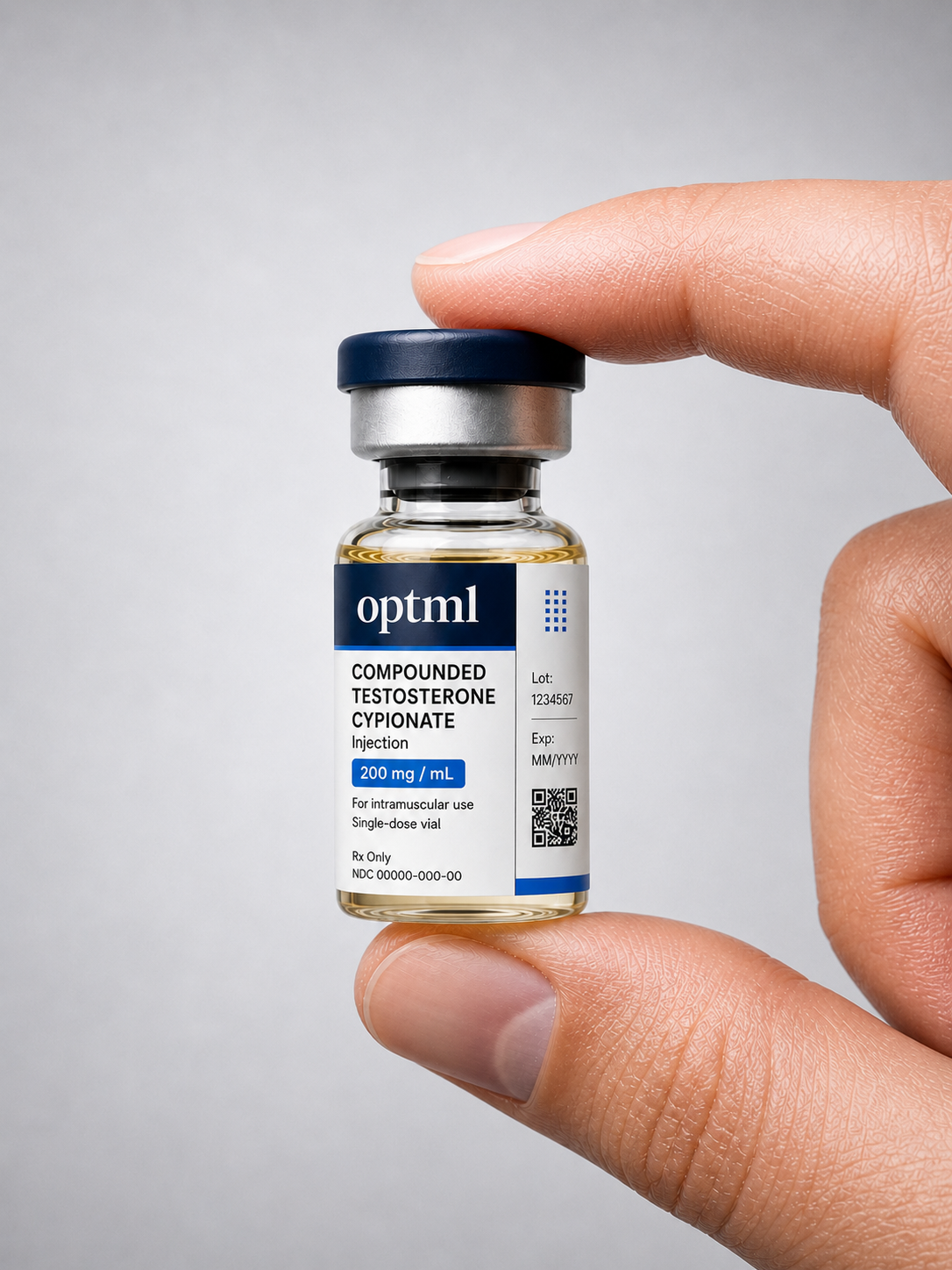
OPTML's TRT protocols use sensitive E2 testing, HCG appropriately, split-dose injection schedules, and AIs only when truly indicated. Built around how you feel, not a cookie-cutter protocol.
Start your evaluationThe bottom line
Estrogen is not the enemy. It's a critical male hormone. For most men on TRT, the right approach is to optimize the protocol, split injections, other telehealth providers dose, adjust HCG, and leave estrogen to find its natural balance. Aromatase inhibitors have a real role for a specific minority. For the majority, they cause more problems than they solve.